Monday, 23 April 2012

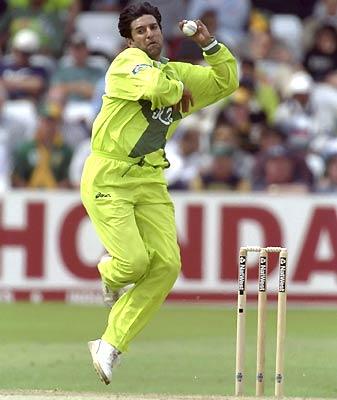
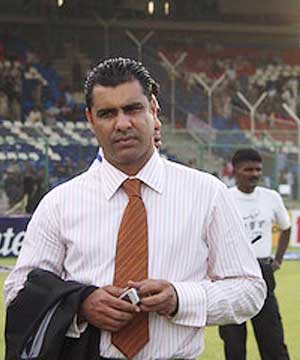
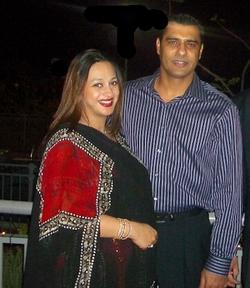
Waqar Younis


Waqar Younis Biography

Waqar Younis Maitla (born November 16, 1971) is a famous Pakistani cricketer from Burewala, Punjab, and one of the greatest bowlers the game has known. He attended Pakistani College, Sharjah and Government College, Vehari. Playing as a fast bowler, he took 373 Test wickets and 416 wickets in One-day Internationals. He debuted for Pakistan against India on November 15, 1989. It is noteworthy that Sachin Tendulkar debuted in the same match. His most lethal weapon was the in-swinging yorker, which he managed to produce at will and with a high degree of accuracy, as experienced first-hand by plenty of county batsmen who were unfortunate enough to face him at his peak.
Known as the "Burewala Bombshell", Waqar formed one half of the legendary fast bowling partnership with Wasim Akram. At his peak, most were of the view that there was no better bowler, especially with regards to wicket-taking ability and being penetrative. His tendency to aim for the stumps earned him the highest strike rate of all time, among the bowlers with 200 or more wickets. His blistering pace and toe-crushing yorkers put tremendous fear in the batsmen. Much was expected of him but he stayed out of the team for quite a long time to do his talents and fans justice because of his controversial conflicts with once bowling partner and captain Wasim Akram. His comeback, however, came with him being appointed the Captain of the national side - which he remained so till his side failed to make an impact in the 2003 World Cup. He was forced to retire as the Pakistan Cricket Board persistently ignored him for national selection.
Waqar was one of a long line of Pakistanis (starting with Safraz Nawaz) who mastered the art of reverse swing. It was his partnership with Wasim Akram that took this art to new levels, and their 1992 series versus England will forever be remembered as their signature series. Many sections of the English media could not fathom how an old ball could swing so much and so late, and this led to cries of foul play and the infamous allegations of "ball-tampering" from some quarteres. The passage of time, coupled with the fact that England now have their own reverse swing bowlers, has led to an appreciation of the science and skill behind reverse swing, and most now accept that Waqar was simply ahead of his time.
Waqar Younis is cited alongside Wasim Akram, Allan Donald, Glenn McGrath, Walsh and Ambrose as the best fast bowler of the 90s. While his contemporaries, Donald and McGrath, played most of their cricket on the fast and bouncy tracks of South Africa and Australia, backed up by the spectacular fielding sides, Waqar Younis, on the other hand, had to contend with the slow and docile tracks of the sub-continent, backed by a fielding side that had nothing so distinguished to write about. An astonishing number of Waqar's wickets have been clean bowled or have come from leg-before decisions showing how much he has had to depend on his own efforts to get his batsmen. He will be known for his attacking bowling as against the "line n' length" bowling of the most of his peers. He bowled one of his best balls to Brian Lara, another cricketing legend, which ended with Lara on the ground, his stump flipped 6 feet away. Waqar Younis has some outstanding records. He is the only bowler who has taken 5 wicket haul in 3 consecutive ODIs. He has taken 4+ wickets on 27 occasions in ODIs, which is a record. He has also taken the fastest 50, 300, 350 and 400 wickets in ODI matches and in test matches he has taken the fastest 150, 200, 250, 300, 350 wickets by lesser number of balls bowled.
Although primarily a bowler, Waqar hit 1010 Test runs; he is in fact (as of September 2005) the only man to pass the thousand mark without ever scoring a fifty. He is now married with a son and a daughter. Recently, he has become a television cricket commentator for Australia's Nine Network since a series against Australia and Pakistan.

Waqar Younis
Waqar Younis
Waqar Younis
Waqar Younis
Waqar Younis
Waqar Younis
Waqar Younis
Waqar Younis
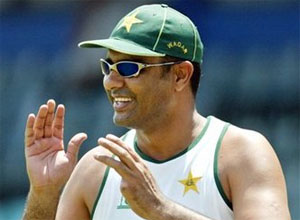
Wasim Akram


Wasim Akram Biography

Wasim Akram (Urdu: وسیم اکرم) (born June 3, 1966 in Lahore, Punjab) is a former Pakistani cricketer. He was a left-arm fast bowler and left-handed batsman, who represented the Pakistani cricket team in Tests and One Day Internationals. Widely regarded as one of the finest fast bowlers ever, Akram holds world records for the most wickets taken in List A cricket (881), and is second only to Muttiah Muralitharan in terms of ODI wickets (502). He is considered to be one of the pioneers of reverse swing bowling.[1][2][3] The revolutionary nature of reverse swing initially resulted in accusations of ball tampering, although reverse swing has now been accepted as a legitimate feature of the game. Akram's later career was also tarnished with accusations of match fixing, although these remain unproven.

Wasim Akram 
Wasim Akram 
Wasim Akram 
Wasim Akram 
Wasim Akram 
Wasim Akram 
Wasim Akram 
Wasim Akram 

Rameez Hasan Raja


Rameez Hasan Raja Biography

Rameez Hasan Raja (born 14 August 1962 in Lyallpur (now Faisalabad), Pakistan) is a former Pakistani cricketer who is now a commentator and has become the voice of Pakistan cricket. He studied at the noted Pakistani institutions, Sadiq Public School, Bahawalpur and Aitchison College, Lahore, and holds a Masters Degree in Business Administration. Rameez was a right-handed opening batsman, and is a former captain of the Pakistani team.

Rameez Hasan Raja
Rameez Hasan Raja
Rameez Hasan Raja
Rameez Hasan Raja
Rameez Hasan Raja
Rameez Hasan Raja
Rameez Hasan Raja
Rameez Hasan Raja

Javed Miandad


Javed Miandad Biography

Javed Miandad was Pakistan’s enfant terrible and a batting warrior for Pakistan cricket. He became famous after hitting the winning six on the last ball of the match in the April 1986 match at Sharjah against the Indian bowler Chetan Sharma [ who no doubt was trying to bowl a Yorker , instead let loose with the famous ball type exemplified by the joke "umpire to batsmen taking guard – yes what do you want – batsmen – a full toss on the leg side" ]. This led many a Pakistani calling up their Indian friends on the phone and saying, " This is Miandad speaking ". His other memorable, gritty performances, and there are many, are documented in this delightful book which is a must for every South Asian cricket lover for a rainy day, weekend/ bedtime as well as a serious cricketer’s reading.

Miandad will always be remembered in the annals of Pakistan as not just a street fighting cricketer but a world class batsman and one whose understanding and deep knowledge of the game has led him to become the coach for the present Pakistan team. His current task [not an easy one] is to lead the Pakistani batting line-up out of the woods.

"Cuttting Edge" is his biography written with the help of his friend Dr. Saad Shafqat .For a cricket lover this is a gem of a book, describing how time and again, the Pakistan cricket team has been blessed with raw unknown outsiders who have made their mark in International cricket. From the anecdote of Wasim Akram, who bowled to him in the nets at Karachi in 1984 [ and was so green that he asked Miandad how much money he should take when he got selected for England] , to Miandad’s early childhood days playing street cricket in Ranchore Lines in Karachi [ using the secret weapon of a tennis ball wrapped up in plastic insulating tape to give extra bounce / swing ] and making his first Test hundred [ 163 ] in his first Test appearance in Lahore’s Gaddafi stadium on October 9, 1976 against a pace attack of Hadlee [ which reduced Pakistan to 44 for 3] , this book is Miandad’s way of telling the story of his rise and rise from the humble streets of Karachi to the sophisticated cricket grounds of Lords in London.
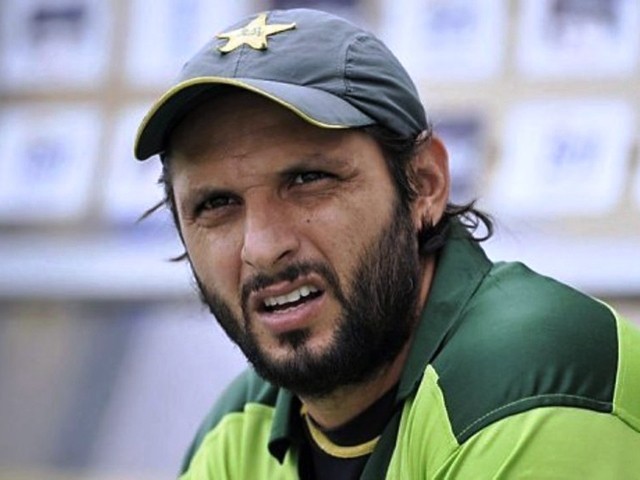
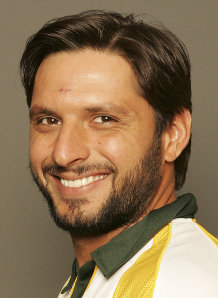
Miandad writes endearingly of how his father [a cotton expert and grader at the Karachi Stock Exchange ] and his father’s best friend A.R.Mahmood [ who taught him to play straight bat in the V area between cover and mid-wicket in the early opening of an innings] became the influences of his boyhood cricket days as a batsman, although he would do everything – bowling off-breaks, and wicket keeping in school.

There are 23 Chapters , with a chapter on the "Sharjah" match with India , another one on "Wars with India" , his batting in the World Cup of 1992. There is one entitled " In search of 365 " [ how to get into the bowlers frame of mind and anticipate his next type of ball ] another entitled " Tit for Tat with the West Indies " [ 1987-88 when West Indies and Pakistan were at their peaks –with players such as Lloyd , Richards , Walsh , Ambrose, Marshall . In all these chapters what finally comes through is that Miandad fought for his mark as a world class batsman [ in the league of the top 10 - ]. There are places where Miandad gets stuck on a sticky issue , where he is at pains to show that there was no squabble between him and Imran Khan, but this is contradicted in another chapter called " Picking the gaps " where he rants and raves against the "Oxbridge complex ".

His apologies to Amarnath in the Jaipur match show his character. Many of his words make him come out as a God fearing humble human being. In fact what comes out of this book and this is what Miandad also says is that character is what makes a batsman. Miandad’s praise for other cricketers – especially Gavaskar, his sense of humor and his famous remark to an opposition bowler to provide him with his hotel room number for he wanted to dispatch the ball straight there. Miandad’s opinion on the best batsmen, bowlers are interesting insights into the extreme competition within the sport [ only 8 countries play this game - 4 from south Asia]. These are wonderful joyous words that make one feel the game of cricket is indeed a great game – slightly colonial in its five-day test series - and that South Asians know that and have produced masters such as Miandad.

Javed Miandad
Javed Miandad
Javed Miandad
Javed Miandad
Javed Miandad
Javed Miandad
Javed Miandad
Javed Miandad

Imran Khan


Imran Khan Biography


 Imran Khan is a retired Pakistani cricket player who has been a politician since the mid-1990s.
Home  • People  • Imran Khan
Print Cite This
Synopsis


Imran Khan Niazi, born in 1952, is a retired Pakistani cricket player who has been a politician since the mid-1990s. He lead the Pakistani cricket team from 1971 to 1992, leading his team to their only World Cup victory in 1992. He is currently the chairman of the Pakistan Tehreek-e-Insaf political party, a small party of which he is the only member ever elected to Parliament.


CONTENTS


Synopsis
Profile
Profile


Cricketer, born in Lahore, NE Pakistan. He studied at Oxford, playing in his first Test at 18 while at the university. One of the greatest all rounders, he was a fast bowler, adaptable batsman, and astute captain who inspired Pakistan's rise to prominence in world cricket. After leading Pakistan to the 1992 World Cup, he retired with a total of 3807 runs and 362 wickets in Test matches. He also played for Sussex and Worcester. His highly publicized nine-year marriage to Jemima Goldsmith ended in 2004. In addition to following a career in politics, forming his own party, Pakistan Tehrik-i-Insaaf (Pakistan Justice Movement), he is a cricket commentator.


Imran Khan
Imran Khan
Imran Khan
Imran Khan
Imran Khan
Imran Khan
Imran Khan
Imran Khan
Imran Khan
Imran khan at his best
Imran Khan's message to Overseas Pakistanis in North America (March 2012)

Shahid Afridi


Shahid Afridi Biography
Sahibzada Mohammad Shahid Khan Afridi (born 1 March 1980 in Khyber Agency), popularly known as Shahid Afridi, is a Pakistani cricketer currently playing for the Pakistani national team in the international circuit. He made his ODI debut on 2 October 1996 against Kenya in Nairobi[1] and his Test debut on 22 October 1998 against Australia at Karachi.[2] He is known for his aggressive batting style, and currently holds the highest career strike rate in the history of international cricket. In a recent survey, Afridi was named as the most popular cricketer in Pakistan.[3] He also holds the record for the fastest one day century which he made in his debut innings, as well as scoring 32 runs in a single over, the second highest scoring over ever in an ODI.

Style

His general style of batting is very aggressive and attack oriented and has earned him the nickname “Boom Boom Afridi” for his fastest One Day International century just in 37 balls. As of 22 May 2007, he has an ODI strike rate of 109.38 runs per 100 balls, the highest in the game’s history. This attitude has been transferred to Test cricket as well, with Afridi scoring at a relatively high strike rate of 86.13 in Tests. He has an approach to batting that can change the tempo of a game and inspire the mood of an audience, as shown when a mass exodus of spectators occurred in Pakistan in late 2005 following his dismissal from the crease. He hits many sixes long and high, favoring straight down the ground or over midwicket. A trademark shot is a crossbatted flick to the leg-side to a ball outside off stump.[8]. This explosive style has led to some memorable shots, most notably the first ever 12 in power cricket in 2002, where Afridi successfully hit the roof. [9] However, his aggressive style increases his risk of getting out and he is one of the most inconsistent batsmen in cricket. This is reflected by the fact that he is the only player to score more than 5000 ODI runs at an average under 25.

Bowling-wise, his stock ball is the leg break, but his armory also includes the conventional off break and a ‘quicker one’ which he can deliver at nearly 80 mph in the style of a medium-pacer. He bowls at a high speed for a spinner, resulting in lesser turn, and relying more on variations in speed. He occasionally sends down a bouncer to a batsmen, which is very rare for a spin bowler.

International career

In October 1996 at the age of sixteen he was brought into the ODI team as a legspinner as a replacement for the injured Mushtaq Ahmed. He then gained notability as a pinch-hitter and began opening with Saeed Anwar. He holds the record for scoring the fastest century in one-day internationals (off 37 balls)[12], scored in only his second match and his first ODI innings. He also shares with Brian Lara the record for the third-fastest century in ODIs (off 45 balls). One of Pakistan’s most useful all-rounders, he has an extremely aggressive batting style, which has garnered him over 5,000 ODI runs (including an erstwhile world-record 249 sixes, recently broken by Sanath Jayasuriya), as well as taking over 250 wickets at ODI and 47 at Test level.

For various reasons, including a perception that he lacks patience in his batting, Afridi had limited opportunity in Test matches, although he currently averages in the high thirties and mid-thirties with bat and ball respectively. As it is, Afridi has featured in less than one third of the Test Matches played by Pakistan over the course of his career.[13] However, he made his presence felt in the third Test against India in March 2005, scoring a quick-fire second-innings half-century and taking five wickets in the match (including Tendulkar twice) to help Pakistan to win the game and register a series draw.

It is perceived that his batting struggles on bouncy pitches and against opponents like Australia, although his record against the Australians has improved over time. Although he has had success as an opener on sub-continent pitches, Afridi is often moved into the lower order as well.

Afridi was more consistent with his batting and bowling throughout 2005, starting with the tours of India and West Indies and through to the England tour. The Pakistani coach Bob Woolmer helped Afridi to reach a fuller potential by improving his shot selection and giving him free rein over his batting attitude.

In the 2007 World Twenty20, he performed poorly with the bat but brilliantly with the ball, earning the Man of the Series award, though he failed to take a wicket in the final and was out for a golden duck.

Career Highlights

* On 4 October 1996, playing his maiden international innings, Afridi hit the fastest One-Day century off 37 balls against Sri Lanka in Nairobi. His innings included 28 runs off one of Sanath Jayasuriya’s overs, whose record he broke. [15]

* Youngest player in history to make an ODI century at just 16 years and 217 days with his 37 ball ton against Sri Lanka. It included 11 sixes and 6 fours. [16]

* Made a half-century from 26 balls and took 3 second-innings wickets in Pakistan’s series-drawing Test victory against India in March 2005.[14]

* Holds the joint record with Brian Lara for the third fastest ODI century off 45 balls in April 2005 against India. [17] This actually was the first match that witnessed the Indian cricketer-turned-commentator Ravi Shastri make him the nickname Boom Boom Afridi.

* Equal highest aggregate sixes scored in the 50-over game, shared the legendary Sri Lankan batsman Sanath Jayasuriya, and he the most sixes per innings record.

* Scored four consecutive sixes off a Harbhajan Singh over in a Test match against India in January 2006, matching a feat that Kapil Dev achieved in 1990.

* Was the first player to score 12 runs off one ball, by hitting the roof of the Millennium Stadium. This took place in a game of Power Cricket.[citation needed][clarification needed]

* Holds four of the top eight fastest ODI half centuries, twice completed in 18 balls and twice in 20 balls. He has also scored a half century off just 21 balls.

* Made 32 runs off a Malinga Bandara over in an ODI game at Abu Dhabi in 2007. He struck four consecutive sixes and it was the 2nd most expensive over in ODI history.

* Afridi is only third player in ODI history to achieve the combination of 5000 runs and 200 wickets. The other players being Sri Lankan batsman Sanath Jayasuriya and South African Jacques Kallis.

Shahid Afridi
Shahid Afridi
Shahid Afridi
Shahid Afridi
Shahid Afridi
Shahid Afridi
Shahid Afridi